Leadership
NIUK 2026 Inaugural Election: A New Chapter for Nigerians in the UK
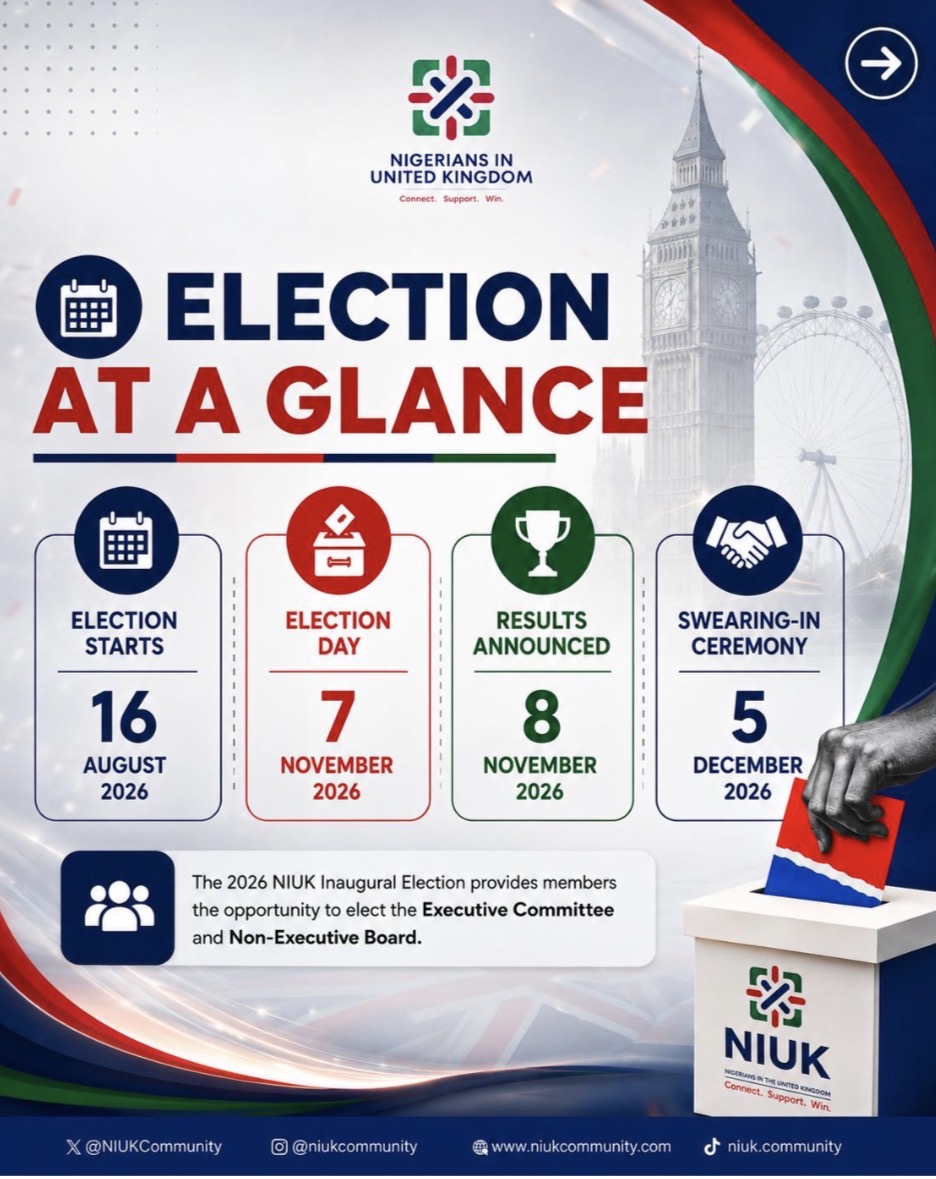
Nigerians in United Kingdom has published its 2026 Inaugural Election Guidelines and Timeline, with online voting on 7 November and the swearing-in on 5 December.
For a community as large and diverse as the Nigerian population in the UK, organising people under one umbrella is no small task.
Now, Nigerians in United Kingdom (NIUK) is preparing for what could become an important moment in its development: its inaugural election.
With the publication of its 2026 Inaugural Election Guidelines and Timeline, NIUK is putting a formal structure around the process of choosing its leadership. More than an election calendar, it offers a glimpse of how the organisation wants to build its leadership and involve members across the UK.
The message running through the process is simple: Connect. Support. Win.
But behind those three words is a bigger question — how does a growing diaspora community create a leadership structure that reflects the people it represents?
A leadership structure for a nationwide community
NIUK members will vote for two separate bodies: an Executive Committee (EXCO) and a Non-Executive Board (NEB).
The EXCO will have nine positions, including President, Vice President, Welfare Secretary and Legal Officer.
The NEB will have seven seats covering regions and specific areas of the community, including England, Scotland, Wales, Northern Ireland and students.
That structure matters because the Nigerian community in Britain is not concentrated in one place. Nigerians live, work, study and raise families across all four nations, with different experiences and priorities.
Giving those regions a defined place within the organisation is an attempt to make representation part of the structure rather than leaving it to chance.
The election calendar
NIUK has also laid out a timetable covering the process from registration to the eventual handover.
The programme began with the publication of the election guidelines in August. Expressions of interest run until 15 September, followed by screening and vetting from 16 September to 3 October.
The final list of candidates is due to be published on 5 October, when campaigning will begin.
“The message running through the process is simple: Connect. Support. Win.”
Voter registration closes on 11 October, ahead of the main event: 24 hours of online voting on 7 November.
The results are expected to be announced during the AGM on 8 November, with the formal swearing-in and handover scheduled for 5 December.
For a diaspora organisation whose members are spread across the country, taking the election online should make participation considerably easier.
Who can vote and who can run?
The guidelines also set conditions for participation.
Members seeking to vote must be registered, verified and up to date with their membership dues. Those seeking office must meet additional requirements, including at least two years of active membership and being in good financial and organisational standing.
The guidelines also place emphasis on integrity, excluding candidates with records of misconduct, fraud or financial impropriety.
That requirement speaks to an issue that goes beyond this particular election. Once an organisation begins to represent a sizeable community, questions of trust, accountability and how money and responsibilities are handled become increasingly important.
More than clicking a button
The election itself may be digital, but its significance is very much about the people behind the screens.
The process has been broken down into seven stages: Register, Nominate, Screening, Campaign, Vote, Results and Swearing-in.
Simple enough.
The real test, however, will be participation.
An election only works when members take an interest, register, ask questions, examine the candidates and eventually cast their votes. For NIUK, this inaugural exercise is therefore an opportunity not only to choose leaders but also to establish the culture of participation that will shape the organisation in the years ahead.
For Nigerians across the UK, the coming months should provide an opportunity to see what kind of leadership emerges and what the community expects from it once the election is over.
Because the real work begins after the votes are counted.
About the author
Victor Ikoli is the Founder and Editor-in-Chief of Vantage Magazine.